

Knowhere is the open-source C++ vector search engine at the core of Milvus. It builds vector indexes and runs similarity search: the distance kernels, the HNSW graph walks, the IVF cluster scans, DiskANN, quantization, and GPU indexes all execute inside Knowhere. Milvus wraps it with everything a database needs (collections, distributed storage, ingestion, filtering, replication, and APIs), so you choose an index in Milvus and Knowhere does the actual math.
The name is a pun on "know where": the engine decides which implementation and which hardware path (CPU instruction set or GPU) should execute a given build or search request.
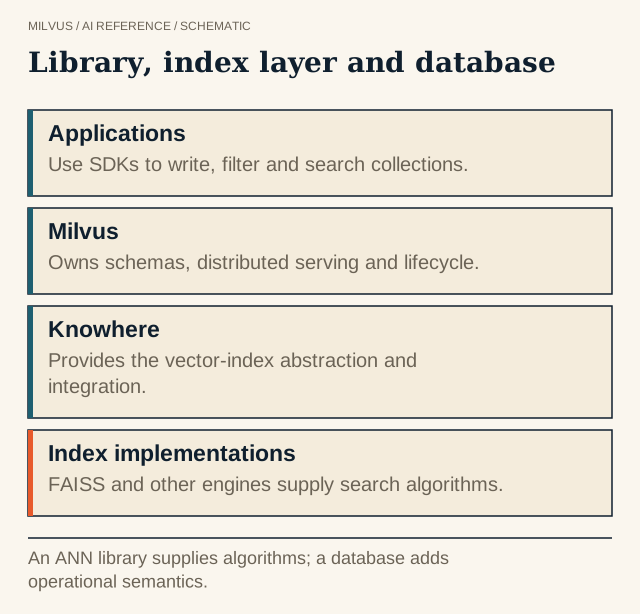 Library, index layer and database. An ANN library supplies algorithms; a database adds operational semantics.
What does Knowhere actually do?
Think of Knowhere as the layer between Milvus’s distributed services and the raw algorithms. Its main jobs are:
- Index building and search. It implements or integrates the index families Milvus exposes: FLAT brute force; IVF_FLAT, IVF_SQ8, IVF_PQ, and IVF_RABITQ; HNSW and its compressed variants HNSW_SQ, HNSW_PQ, and HNSW_PRQ; SCANN; DISKANN for SSD-resident graphs; binary indexes such as BIN_FLAT, BIN_IVF_FLAT, and MINHASH_LSH; SPARSE_INVERTED_INDEX for sparse vectors and BM25 full-text scoring; and GPU indexes (GPU_CAGRA, GPU_IVF_FLAT, GPU_IVF_PQ, GPU_BRUTE_FORCE) built on NVIDIA’s cuVS.
- Distance computation. L2, inner product, and cosine for float vectors; Hamming and Jaccard for binary vectors; IP and BM25 for sparse vectors.
- Hardware dispatch. On x86 it detects the CPU at runtime and picks the best available SIMD path (SSE, AVX2, or AVX-512) without a special build; it also builds for ARM (aarch64, including Apple Silicon) and, with
WITH_GPU=True, for CUDA GPUs. - Filtering during search. Every search accepts a bitset that marks which rows are ineligible, whether because they were deleted or excluded by a scalar filter. Those rows are skipped inside the index traversal, so filtered and deleted rows never take a slot in your top-k.
In Milvus terms, each index type is described by three parts (a data structure such as an IVF partitioning or a graph, an optional quantizer such as SQ8 or PQ, and an optional refiner that re-scores candidates at higher precision), and all three live in Knowhere.
How does Milvus call Knowhere?
Milvus’s distributed services are written in Go; the execution core (segcore) and Knowhere are C++. When a Data Node builds an index for a sealed segment, it loads that segment’s vectors and hands them to Knowhere with your index parameters (M and efConstruction for HNSW, nlist for IVF, and so on); the serialized index is written to object storage. When a Query Node serves a search, segcore evaluates the filter expression into a bitset, then calls Knowhere on each loaded segment with the query vectors, limit, search parameters such as ef or nprobe, and the bitset. Knowhere returns candidate IDs and distances, and Milvus merges results across segments, shards, and nodes.
Because Knowhere works one segment at a time, it never has to know about shards, replicas, consistency levels, or schema. That separation is what lets Milvus scale out across many machines while keeping the vector engine a focused, heavily optimized library. The Milvus architecture page shows where segment search fits in the full request path.
How is Knowhere different from FAISS?
FAISS is Meta’s vector search library and one of the libraries Knowhere integrates. Knowhere is not a replacement for FAISS so much as a layer that adapts several libraries (FAISS, hnswlib-derived HNSW, DiskANN, cuVS) to the needs of a database.
| FAISS | Knowhere | Milvus | |
|---|---|---|---|
| What it is | Similarity-search library | Vector engine inside Milvus | Distributed vector database |
| Index families | IVF, PQ, HNSW, flat, GPU indexes, and more | FAISS-based IVF plus HNSW, DiskANN, SCANN, sparse inverted, cuVS GPU indexes | Exposes Knowhere’s indexes per field |
| Filtering and deletes | ID selectors you wire up yourself | Bitset applied inside every search path | Filter expressions and deletes compiled into bitsets automatically |
| Persistence, updates, scaling | Your responsibility | Per-segment only | Handled: WAL, object storage, compaction, sharding, replicas |
| Typical use | Embedded experiments, research, custom systems | Not used directly by applications | Production applications |
Knowhere’s early design notes list concrete additions on top of FAISS: bitsets on every exposed query API, extra binary metrics, AVX-512 kernels (reported as 20 to 30 percent faster than AVX2 for build and query at the time), and automatic SIMD selection. If you are deciding between a library and a database, the FAISS explainer goes deeper.
Should you use Knowhere directly?
Usually not. Knowhere is an independent Apache-2.0 project with its own build and a Python wheel, which makes it useful for contributors, index researchers, and people benchmarking algorithms in isolation. Applications should go through Milvus, which pins a specific Knowhere revision per release and tests that combination. A feature that appears on a Knowhere branch reaches users only once a Milvus release exposes it, so check the Milvus docs for your version before relying on a new index type or vector data type.
For the same reason, a Knowhere microbenchmark and a Milvus benchmark answer different questions. The first measures a single segment’s index; the second includes filtering, multiple segments, growing data, merging, network, and concurrency. Both are useful, but only the second tells you whether an application will meet its latency target.
How do you choose an index that Knowhere will run?
Pick the index in Milvus based on data size, memory budget, recall target, and hardware:
- HNSW for low-latency, high-recall in-memory search; add SQ, PQ, or PRQ to trade some recall for memory. See what is HNSW.
- IVF variants for faster builds and smaller footprints, tuned with
nlistandnprobe; IVF_RABITQ for aggressive 1-bit compression with refinement. - DISKANN when the dataset is larger than RAM but you have fast NVMe. See when to use DISKANN.
- GPU_CAGRA when you need very high throughput and have supported NVIDIA GPUs. See what is GPU_CAGRA.
- FLAT for small collections or as an exact baseline to measure recall against.
Whatever you choose, evaluate it the same way: fix the vectors, metric, query set, limit, and filter; compute exact results with FLAT; then measure recall, p99 latency, throughput, memory, and build time across realistic filter selectivities and with data changing underneath. The index selection guide walks through the decision.
Related reading
- How does the Milvus architecture separate ingestion, storage, and search?
- How do you choose a vector index for your workload?
- What is FAISS, and how does it relate to vector indexes?
- When should you use DISKANN in Milvus?
- What is GPU_CAGRA, and when does it help vector search?
To see Knowhere at work without building anything, create an HNSW or IVF index in the Milvus Quickstart, then read Index Explained to compare the options.


