

Hugging Face RankerCompatible with Milvus v2.6.20+
Vector search orders results by vector distance, but the initial order may not reflect how well each candidate’s text answers the query. Hugging Face Ranker sends query and candidate text to hosted Hugging Face Inference Providers and uses sentence-similarity scores to reorder the candidates returned by Milvus.
This integration uses the hosted Hugging Face router. To rerank with a separately deployed Text Embeddings Inference (TEI) service, see TEI Ranker.
Limits
- The Function must reference exactly one non-nullable
VARCHARfield ininput_field_names. - The number of strings in
queriesmust equal the number of search queries (nq).
How it works
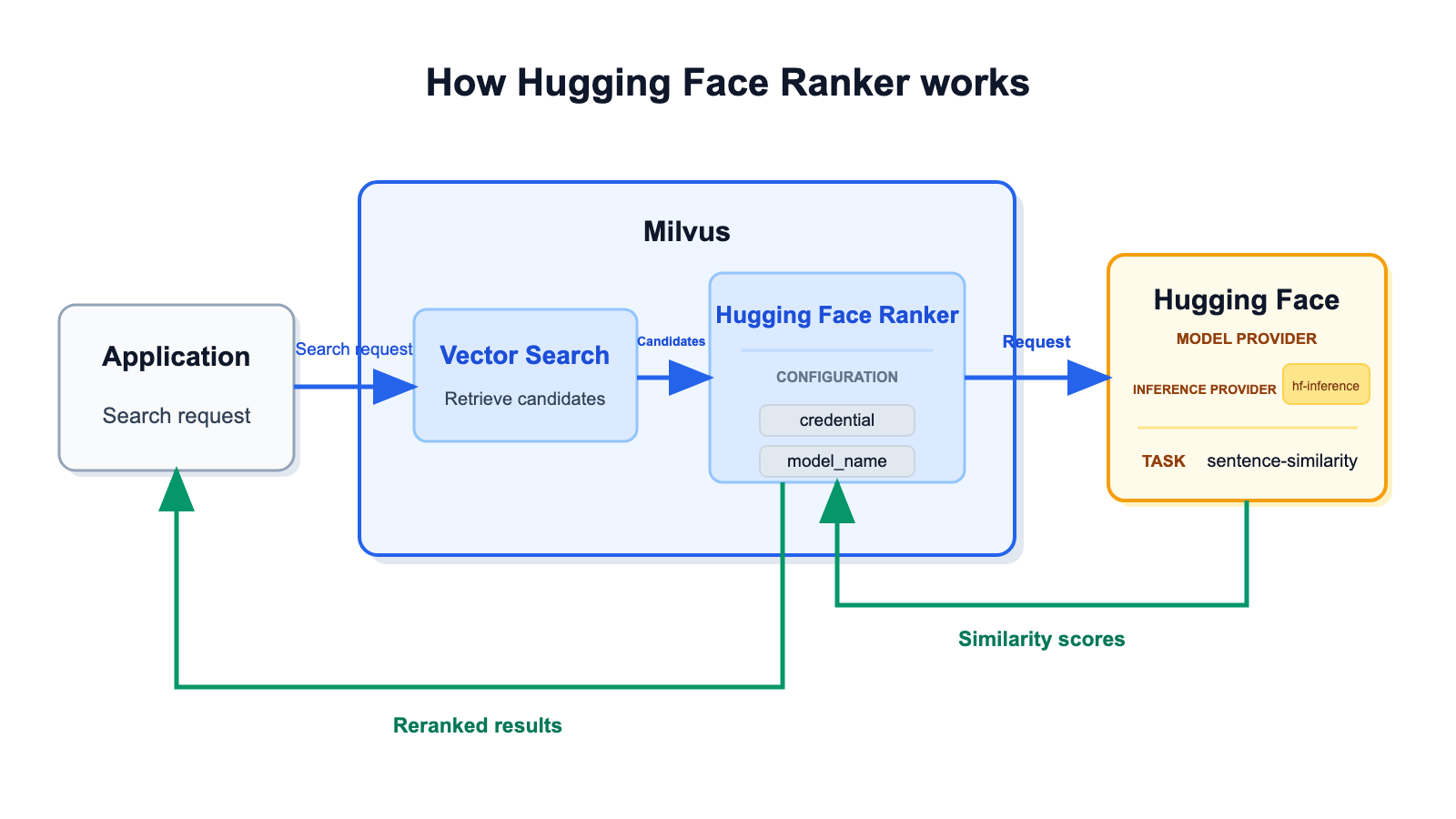 Hugging Face Ranker workflow
Hugging Face Ranker runs after the initial vector search:
- Retrieve candidate entities. Milvus searches the configured vector field and collects candidate entities.
- Prepare text for reranking. The Function reads query text from
params.queriesand candidate text from theVARCHARfield specified ininput_field_names. - Request similarity scores. Milvus sends the query as
source_sentenceand the candidate texts assentencesthroughhf-inferenceto the Hugging Facesentence-similaritypipeline. - Rerank the candidates. Hugging Face returns one score per candidate. Milvus orders candidates from highest to lowest score and returns the reranked results.
How similarity scores are calculated
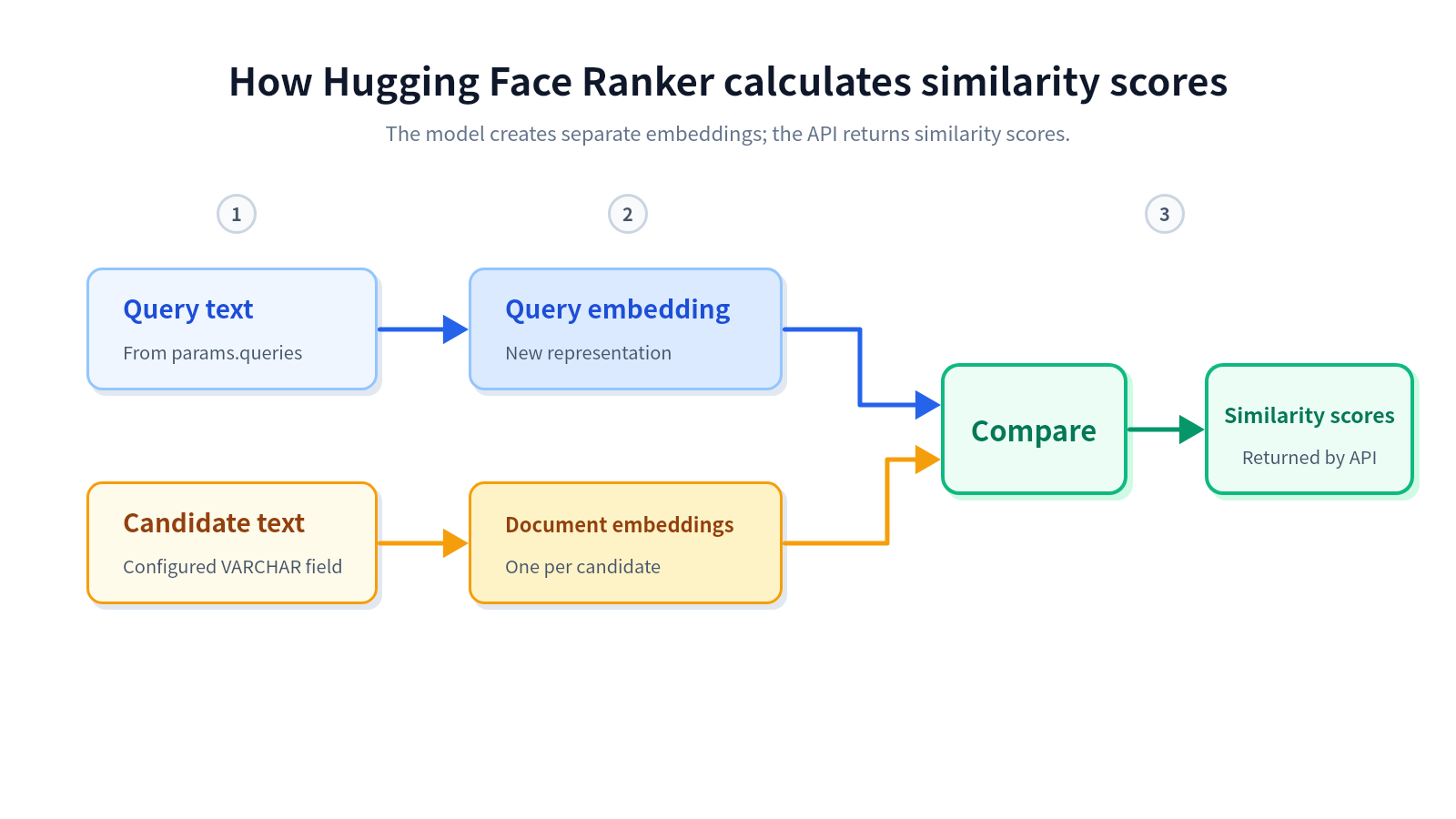 How Hugging Face Ranker calculates similarity scores
The Hugging Face model calculates the scores in three stages:
- Prepare the text inputs. The Ranker reads the query text from
params.queriesand candidate text from the configuredVARCHARfield. - Create separate model representations. Milvus sends the query as
source_sentenceand candidate texts assentences. The model internally encodes the query and each candidate separately. - Compare and return scores. The model compares the query representation with each candidate representation and returns one similarity score per candidate.
The embeddings or representations used by the Hugging Face model are intermediate model processing. Hugging Face returns scores, not vectors. Initial vector retrieval and model reranking therefore use separate representations and may use different models.
Before you start
Before using Hugging Face Ranker, ensure that you have:
- Milvus 2.6.20 or later in the 2.6 release line.
- PyMilvus 2.6.16 or later.
- A Hugging Face User Access Token that can call Inference Providers.
- A model currently served by
hf-inferencefor thesentence-similaritytask. - A collection that stores candidate text in a non-nullable
VARCHARfield.
Milvus does not control whether a Hugging Face model remains available through hf-inference, or whether the model meets your stability, latency, and output-quality requirements. Verify the model on Hugging Face and evaluate it for your workload before using it in production.
The examples use sentence-transformers/all-MiniLM-L6-v2 only to demonstrate the configuration. The model is not a Milvus recommendation or certification.
Configure credentials
You can configure the Hugging Face User Access Token in milvus.yaml or through an environment variable.
Credential precedence is:
Function credential label -> provider credential label in milvus.yaml -> environment variable
Option 1: Configuration file
Define the token under the top-level credential section, then point the Hugging Face ranker provider to the credential label:
# milvus.yaml
credential:
  huggingface_apikey:
    apikey: <YOUR_HUGGING_FACE_TOKEN>

function:
  rerank:
    model:
      providers:
        huggingface:
          credential: huggingface_apikey
          # url: https://router.huggingface.co
A Function-level credential parameter can override the provider-level label. Its value must be a credential label defined in milvus.yaml, not the token itself.
Option 2: Environment variable
If neither the Function nor the provider configuration specifies a credential label, set MILVUS_HUGGINGFACE_API_KEY in the Milvus service environment:
# docker-compose.yaml
standalone:
  environment:
    MILVUS_HUGGINGFACE_API_KEY: <YOUR_HUGGING_FACE_TOKEN>
Use Hugging Face Ranker
Hugging Face Ranker is defined and applied at search time. You can change or omit the ranker for each search without changing the collection schema.
Step 1: Prepare a collection
The following example creates a collection with a text field for reranking and a vector field for initial retrieval:
from pymilvus import DataType, Function, FunctionType, MilvusClient

client = MilvusClient(uri="http://localhost:19530")

collection_name = "hugging_face_rerank_demo"
schema = client.create_schema()
schema.add_field("id", DataType.INT64, is_primary=True, auto_id=False)
schema.add_field("document", DataType.VARCHAR, max_length=1000)
schema.add_field("dense", DataType.FLOAT_VECTOR, dim=4)

index_params = client.prepare_index_params()
index_params.add_index(
    field_name="dense",
    index_type="AUTOINDEX",
    metric_type="COSINE",
)

client.create_collection(
    collection_name=collection_name,
    schema=schema,
    index_params=index_params,
)

client.insert(
    collection_name=collection_name,
    data=[
        {
            "id": 1,
            "document": "Recent renewable energy developments include improved solar efficiency.",
            "dense": [0.10, 0.20, 0.30, 0.40],
        },
        {
            "id": 2,
            "document": "Climate policy and carbon markets have evolved rapidly in recent years.",
            "dense": [0.11, 0.19, 0.28, 0.39],
        },
        {
            "id": 3,
            "document": "New battery technology helps stabilize wind and solar power generation.",
            "dense": [0.90, 0.10, 0.05, 0.02],
        },
        {
            "id": 4,
            "document": "Vector databases support similarity search for machine learning applications.",
            "dense": [0.01, 0.02, 0.03, 0.04],
        },
    ],
)
Step 2: Define the rerank Function
Define a RERANK Function that reads candidate text from document and uses the query text in queries:
hugging_face_ranker = Function(
    name="hugging_face_semantic_ranker",
    input_field_names=["document"],
    function_type=FunctionType.RERANK,
    params={
        "reranker": "model",
        "provider": "huggingface",
        "model_name": "sentence-transformers/all-MiniLM-L6-v2",
        "hf_provider": "hf-inference",
        "queries": ["renewable energy developments"],
        "credential": "huggingface_apikey",
        "max_client_batch_size": 32,
    },
)
If you use only the provider-level credential or environment variable, omit credential from the Function parameters.
The following table describes the Hugging Face Ranker parameters:
| Parameter | Required? | Description |
|---|---|---|
reranker | Yes | The reranking implementation. Set this value to model. |
provider | Yes | The model provider. Set this value to huggingface. |
model_name | Yes | The Hugging Face model ID for a model served through hf-inference for the sentence-similarity task. |
queries | Yes | Query strings used for reranking. Provide exactly one string per search query, even when initial retrieval uses query vectors. |
hf_provider | No | The Hugging Face Inference Provider route. The default and only supported value in Milvus 2.6.20 is hf-inference. |
credential | No | The label of a credential defined in the top-level credential section of milvus.yaml. This value is not the token itself. |
max_client_batch_size | No | The maximum number of candidate texts sent in one Hugging Face request. The default value is 32, and the value must be greater than 0. |
Step 3: Search with the ranker
Pass the Function through the ranker parameter of search():
query_vector = [0.12, 0.21, 0.29, 0.41]

results = client.search(
    collection_name=collection_name,
    data=[query_vector],
    anns_field="dense",
    limit=3,
    output_fields=["document"],
    ranker=hugging_face_ranker,
    consistency_level="Strong",
)

print(results)
Milvus first retrieves candidates from dense, then uses the query text in queries and the candidate text in document to calculate sentence-similarity scores. The returned candidates are ordered by the Hugging Face scores.
Troubleshooting
The model is unavailable for sentence similarity
Open the model page on Hugging Face and check the Inference Providers section. Confirm that hf-inference serves the model for sentence-similarity. If not, select another model that supports the task.
The number of query strings does not match the search request
The number of strings in queries must equal the number of search queries (nq). For a search with one query vector, provide exactly one query string.
Candidate text is missing or nullable
Ensure that input_field_names contains exactly one non-nullable VARCHAR field and that every candidate entity contains text in that field.
Milvus reports missing Hugging Face credentials
Confirm that the Function credential label exists in milvus.yaml, that the provider-level label is valid, or that MILVUS_HUGGINGFACE_API_KEY is present in the Milvus service environment.
Next steps
- For shared model-ranker behavior and limits, see Model Ranker Overview.
- To generate embeddings through hosted Hugging Face Inference Providers, see Hugging Face.
- To apply the ranker to hybrid search, see Multi-Vector Hybrid Search.